
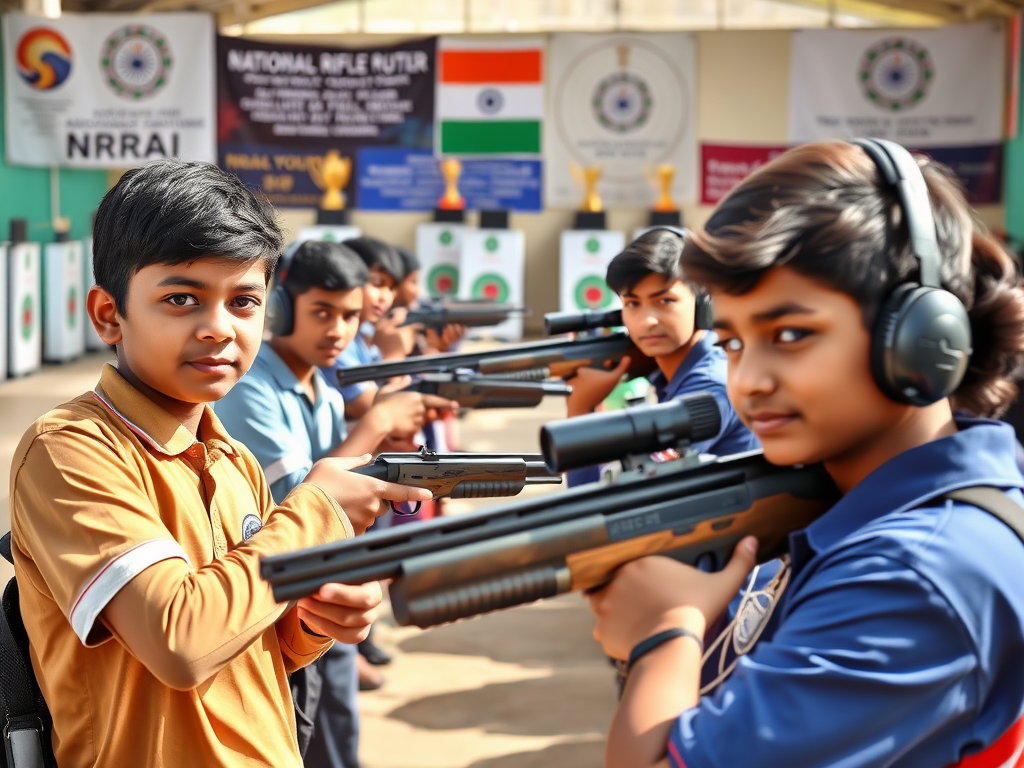
Shooting sports in India follow a structured pathway from grassroots club competitions to national championships. The competitions have clear age categories, minimum qualifying scores (MQS), and progressive stages that prepare athletes for international representation. This article provides a comprehensive overview of the competitions. It also details out cutoff scores, age groups, and the journey from beginner to elite levels.
Introduction
Shooting has emerged as one of India’s most successful Olympic sports. It has produced champions like Abhinav Bindra, Gagan Narang, and Manu Bhaker. Behind these achievements lies a well-defined competitive structure. The competitions are managed by the National Rifle Association of India (NRAI) and state rifle associations like WBRA. This system ensures that shooters progress through age-appropriate competitions, meet qualifying benchmarks, and gain exposure to increasingly competitive environments.
Governing Bodies
- National Rifle Association of India (NRAI): Apex body overseeing shooting sports, affiliated with the International Shooting Sport Federation (ISSF). It is responsible for Nation level competition and National squad selection.
- State Rifle Associations: These bodies Conduct district and state level competitions. It is responsible for state level team selection. State associations are affiliated to NRAI. Some of the leading state Associations are Delhi State Rifle Association, Maharashtra Rifle Association and West Bengal Rifle Association.
- Clubs and Academies: These bodies Provide grassroots training and organize beginner competitions. These are affiliated to state associations in most cases. Some of the leading academies are Gun for Glory Shooting Academy, Tapasya Shooting academy. Some of the oldest clubs organizing competitions are Serampore Rifle club and Asansol Rifle club.
Age Groups in Indian Shooting
Competitions at all levels are divided into age categories to ensure fair play and structured development:
- Sub Youth (Under 15 years)
- Youth (Under 18 years)
- Junior (Under 21 years)
- Senior (21 years and above)
These categories align with ISSF guidelines and NRAI regulations, allowing athletes to compete against peers of similar age and experience. There is no finals in Nationals for Sub Youth category. The finals start from Youth category. Shooters from Sub Youth category can apply for Youth as well as other categories. But Shooters from older age group can not apply in younger age group.
Stages of Progression
Below are the different stages of competitions for Shooters. It is aimed at steady one step at a time progression from grass root level to National level.
Beginner Level – Club & District Competitions
These competitions are organized by local clubs and district rifle associations affiliated to State Rifle Associations. Entry level shooters face minimal qualifying requirements. Often these competitions do not have any qualification requirements.
Players from different academy or schools participate in this go get feel of competition. Typically, these competitions are held in Paper target. These competitions help in learning competition rules, handling match pressure, and achieving consistency.
There is No cut off score in these competitions. Idea is to increase participation and have new shooters get feel of competitive shooting
State Level Competitions
These competitions are Conducted by state rifle associations. It is open to all shooters. Shooters who have not played in Nationals are grouped under NR category. Nationals appeared Shooters are grouped in ISSF category.
NR category shooters compete in Non decimal matches of 40 shots. Nationals appeared Shooters compete in Decimals scoring in 60 shots.NR Shooters must achieve Minimum Qualifying Scores (MQS) to participate in Zonal competition.
The MQS is age wise and if you qualify in your age group you are eligible for Zonal competition. The MQS is different for different shooting sports. MQS varies by discipline (10m air rifle, 10m air pistol, shotgun). These competitions are held in Sius or Electronic scoring system.
Example: For 10m Air Rifle (Youth), MQS may be around 380/400 for Seniors.
Pre National & Zonal Competitions
This is Intermediate stage before nationals. This competition is played by Shooters in NR category who have not yet played Nationals. This is gateway to National competition. It is very important competition for Nationals going shooters.
Those already played Nationals do not play it as they are already Nationals qualified. Shooters compete regionally, refining skills against stronger opponents. The Zonal competition is region wise. These competitions are held in Sius or Electronic scoring system.
For example West Bengal shooters fall under East Zone. So they compete against Shooters from Bihar, Jharkhand, Chhattisgarh and Orissa. The MQS is different for different shooting sports. MQS varies by discipline (10m air rifle, 10m air pistol, shotgun).
National Championships
The Nationals are Organized annually by NRAI. This is the biggest domestic competition for Shooters of India. Shooters compete in 60 shots match in decimal format. These competitions are held in Sius or Electronic scoring system. The MQS is different for different shooting sports. MQS varies by discipline (10m air rifle, 10m air pistol, shotgun). The Nationals is often held in month of December every year.
Based on the scores in Nationals Shooters qualify for the National selection trials. The finals are conducted for Youth, Junior and Senior category for top eight shooters.
Selection Trials & National Squad
Top shooters from nationals who meet MQS eligibility enter NRAI trials. Trials determine selection for World Cups, Asian Games, and Olympics. There are Six trials conducted over a period of one calendar year (between two Nationals competition). Based on the performance in these Six trials and Nationals Shooters are selected for National squad. The selection is in the age group they are eligible for.
The National squad selection is based on top four recent performances. After every selection trials ranking list is published and top ranking shooters are called for National team.
Cut Off Scores Explained
Cut off scores or minimum qualifying score is the least score for appearing in next higher-level competition. This filters the shooters and prepares them for next higher level. MQS (Minimum Qualifying Score) score required to enter a competition Varies by discipline.
It is different for Air Rifle, Air Pistol and Shotgun. It also varies based on competition as well. It will be different for 10 M Air Rifle and 3P Air Rifle. Below information gives you idea about rough range of these scores. MQS ensures only consistent shooters progress, raising competitive standards.
- 10m Air Rifle (Men): ~370–390/400 depending on level.
- 10m Air Pistol (Women): ~360–380/400.
- Shotgun (Trap/Skeet): MQS based on hits out of 125 targets.
Pathway to International Representation
Every young child entering Shooting sports wants to represent India in Olympics and International level. The gradual progression path for International and Olympics representation is shown below.
- District → State → National Championships
- National Trials (Top performers only)
- National Squad Selection
- International Competitions (ISSF World Cups, Asian Games, Olympics)
This pathway ensures merit-based progression, with cutoff scores and ranking acting as filters at each stage.
Shooting Sports Challenges
Shooting is niche sports. There is not much information available online or offline. I have listed some challenges Parents and Shooters face. Some of these challenges are faced by me as well. It is better to understand these challenges up front before making a decision.
- Accessibility: Shooting is expensive due to equipment and ammunition costs.
- Infrastructure: Limited ranges in smaller towns. Lack of coaching expertise in small towns.
- Awareness: Many parents and students are unaware of structured pathways.
- Pressure: High cutoff scores demand consistent excellence, leading to mental stress.
Shooting Sports Opportunities & Growth
India’s success in shooting has led to increased investment in academies. Grassroots initiatives (e.g., Gun for Glory, state academies, School games) are expanding reach. The number of academies and coaching ranges are also increasing with time. Tier 1 and Tier 2 cities have decent coverage of ranges.
NRAI’s structured pathway ensures transparency and meritocracy. Rising participation among women and youth signals a bright future. Government has also categorized Shooting as priority sports.
All these are making life easier for Parents as well as Shooters. Now it is easy to get equipment in India as well. Most of the equipment are imported but companies exist which eases the process.
Conclusion
Shooting sports in India offer a clear, merit-based progression from beginner to national level. Shooting sports have age specific categories, defined cutoff scores, and structured competitions. The system ensures that only the most consistent and disciplined athletes reach the national squad.
While challenges remain in accessibility and infrastructure, India’s growing success at the international stage reflects the strength of this pathway. The success has also fueled growth and now lot of traction is being seen in the Shooting sports. The Shooting premier League launch or announcement is one big positive for the Shooters.
Leave a Reply